OPERATING ENVIRONMENT
The Reserve Bank of Zimbabwe (RBZ) continued to prioritise monetary and exchange-rate stability while gradually adjusting interest rates in line with inflationary developments. Following a reduction from 35% to 30% in June 2026, the Bank Policy Rate was lowered further to 27.5% in September 2026. The targeted finance facility rate was also reduced from 15% to 12.5%. Statutory reserve requirements remained unchanged at 30% for demand deposits and 15% for savings and time deposits. These adjustments did not represent broad-based monetary easing, with liquidity discipline, positive real interest rates and reserve-backed confidence remaining central to the policy stance.
Price and exchange-rate stability were broadly retained during the quarter. The annual Zimbabwe Gold (ZIG) inflation eased to 2.9% in August 2026 before increasing to 3.7% in September 2026, mainly reflecting higher rentals, fuel and lubricant prices. Month-on-month ZWG inflation averaged 0.4% over the nine months to September, while the interbank exchange rate remained broadly within the USD1:ZWG25–27 range during 2026. Zimbabwe continued to operate a multi-currency regime, with the US dollar remaining dominant in pricing, savings and investment decisions despite improved local-currency stability.
Zimbabwe’s economic outlook remained cautiously positive, with the September 2026 Monetary Policy Committee retaining a 5.0% GDP growth expectation for 2026, supported by mining, agriculture and increased activity in the services, utilities, construction and retail sector. Strong mineral exports and diaspora remittances supported external inflows and the current-account position. However, formal-sector competitiveness remained constrained by multiple taxes, levies, licensing obligations, regulatory costs and uneven competition from the informal sector, reinforcing the need for continued business-cost reforms. Downside risks included policy uncertainty, pressure on export competitiveness from the use of the USD, power-supply constraints and possible El Niño-related disruption to the 2026/27 agricultural season. Heightened Middle East tensions and elevated oil prices also continue to pose risks to energy costs, supply chains, inflation and growth.
On the investment front, listed equities continued to deliver positive returns during Q3 2026, with the ZSE All Share Index gaining 13% and the VFEX All Share Index advancing 6.0%. The ZSE All Share Index recorded a year-to-date return of 70% to September 2026. Despite these gains, ZSE liquidity constraints and high trading costs remained challenges. Money-market lending conditions stayed restrictive notwithstanding the policy-rate reduction, with one-year ZWG prime lending rates broadly unchanged at 42% to 48%. Indicative US dollar 90-day deposit rates ranged from 3% to 5.5% for Tier 1 banks and approximately 7% to 12.5% for Tier 2 banks, while US dollar Treasury Note yields were 11% to 14%. Higher-yielding instruments continued to carry greater credit and liquidity risks, supporting a preference for short-dated placements.
The investment outlook favours selective exposure to equities, hard-currency-linked assets and income-generating real assets. VFEX-listed US dollar earners offer currency-risk mitigation, while ZSE stock selection should emphasise pricing power, US dollar revenues and low leverage. Well-located, US dollar-leased property remains a defensive allocation for income and capital preservation, although liquidity and funding costs require careful management. Secured US dollar money-market instruments remain attractive for short-term liquidity, while ZWG exposure should remain tactical and short-dated. The Group will continue to prioritise its real asset strategy as a prudent hedge against downside risks, while positioning for growth through the rollout of relevant and innovative products and service offerings.
BASIS OF PREPARATION
The Group’s consolidated financial statements have been prepared in accordance with International Financial Reporting Standards (IFRS Accounting Standards) as issued by the International Accounting Standards Board (IASB), including interpretations issued by the IFRS Interpretations Committee (IFRIC). The financial statements also comply with the relevant provisions of the Zimbabwe Companies and Other Business Entities Act and the applicable listing requirements of the Zimbabwe Stock Exchange (ZSE).
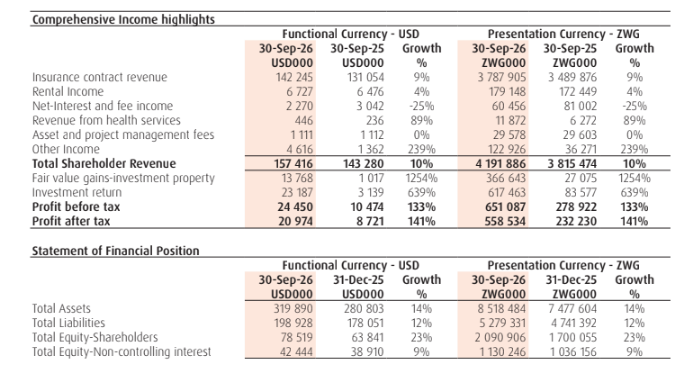
OPERATIONS REVIEW
The Board of Directors of the Group hereby presents to the shareholders the unaudited financial results for the period ended 30 September 2026.
The Group recorded consolidated shareholder revenue of $157.4 million, representing a 10% increase compared to $143.3 million in the prior comparative period. Growth was driven primarily by Insurance Contract Revenue (ICR), Self-Insured medical fund administration fees included in other income and rental income. ICR increased by 9% year-on-year, driven by continued growth in the in-force portfolio business. This performance underscores the resilience of our franchise, with customer demand for insurance products remaining strong. Rental income remained stable, increasing marginally by 4%, despite a decline in occupancy levels. Net interest and fee income declined by 25%, largely due to lower yields on interest-bearing assets.
The Group delivered a significant improvement in profitability, with profit before tax increasing by 133% to $24.5 million and profit after tax rising by 141% to $20.9 million. The improved performance was largely driven by strong investment returns from equities listed on the VFEX and ZSE complemented by dividend and interest income. Fair value gains on investment properties increased significantly by 1,254% to US$13.7 million, reflecting the appreciation in property values during the period.
OUTLOOK
The Group enters the final quarter of 2026 with improved earnings and a strengthened financial position. Management will focus on sustaining this momentum through disciplined underwriting, effective cost management, improved cash generation and prudent capital allocation.
The Group will continue to pursue growth opportunities across its diversified business portfolio, with emphasis on improving business efficiencies, optimising asset utilisation and allocating capital towards initiatives that deliver attractive risk-adjusted returns. These priorities, supported by robust risk management and financial discipline, will remain central to enhancing long-term shareholder value.
By order of the Board
Dulcie Kandwe
Company Secretary
Related Download
FMHL – Trading Update for the third quarter ended 30 September 2026